
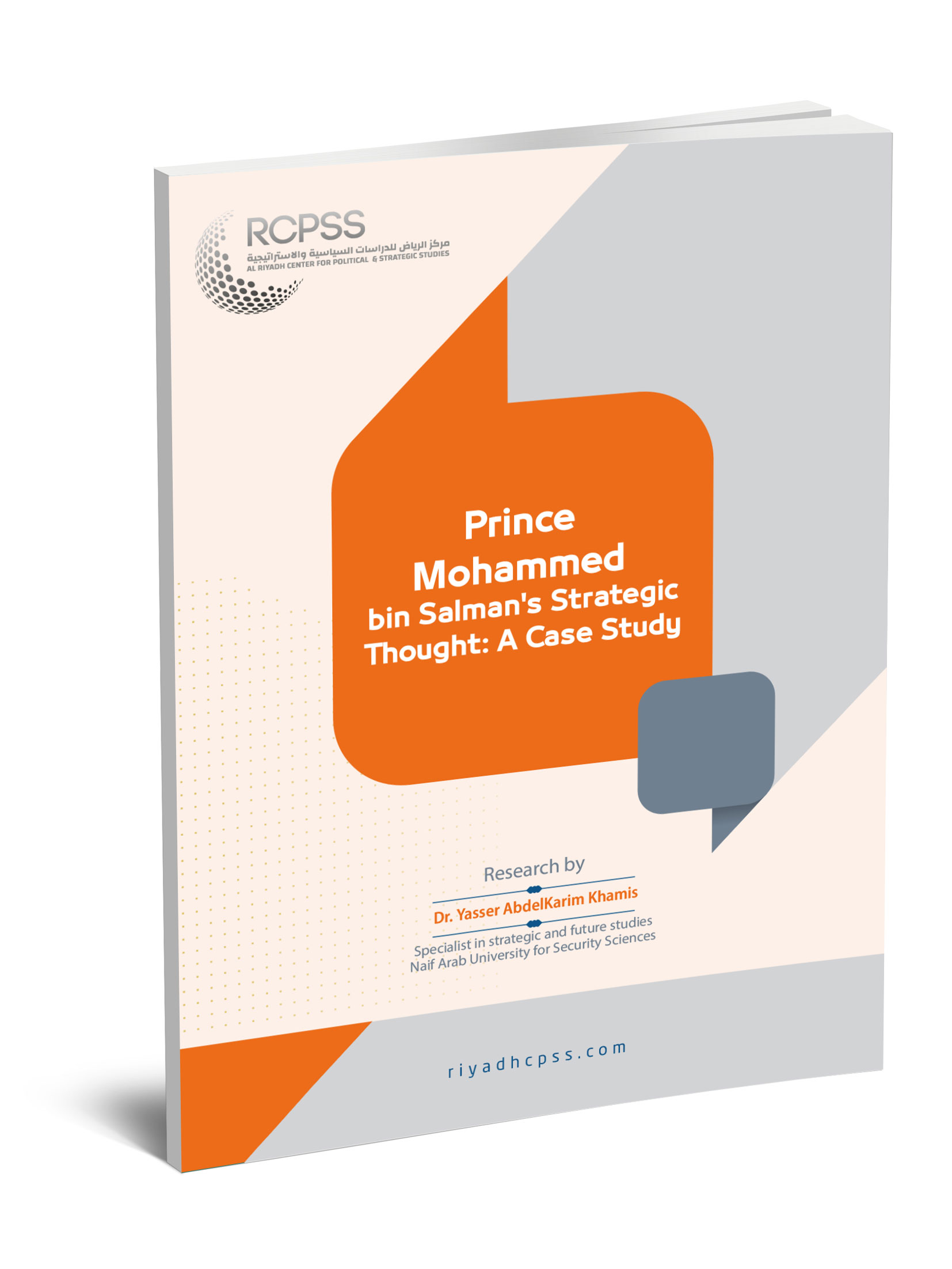
Prince Mohammed bin Salman’s
Strategic Thought: A Case Study
A study conducted by: Dr. Yasser AbdelKarim Khamis
The study delves into the creative and innovative qualities of the leadership characteristic of His Highness, Crown Prince Mohammed bin Salman, which emerged through qualitative and creative strategic thought and insightful vision in choosing his development projects, which left a clear imprint on the modern face of the Kingdom, which made it the focus of the world’s attention during a record period. .
The study also discusses, in brief, the development boom the Kingdom has witnessed since the launch of its Vision 2030 at all political, military, economic, social, cultural, technical and tourism levels Read More
Related products
-
THE HISTORY AND LEGACY
OF THE SAUDI FOREIGN POLICY
A study conducted by Dr. Ibrahim Fouad Abbas
The Saudi position towards the Palestinian case is unique in terms of stability and continuity for more than a hundred years, and the provision of all forms of support to the cause and the Palestinian people without interruption during this long period of time – even before the discovery of oil – is a remarkable phenomenon in contemporary Arab history that history will record in golden letters.
-
What makes us unable to change for the better, even though culture comply with all the rules…Millions of novels and poems are published, as well as newspapers and magazines, and in contrast.. many trees are cut down for it.. But why are we heading towards a world invaded by a culture of violence and the threat of the other?
-
With the end of immediate hazards military , the Kingdom of Saudi Arabia shall be knew that it was time to regain its sovereignty over the two islands (Tiran and Sanafir), This was to meeting that brought together the Foreign Ministers of the Kingdom, Prince Saud Al-Faisal, and the Egyptian Foreign Minister, Esmat Abdel-Majid,,,
-
Actually read and look ahead
A study conducted by: Noura Al-Ahwali
The study dives into the turbulent Tunisian reality more than ten years after the revolution, which sparked on December 17, 2010, shedding light on the Tunisians’ demands for social justice, economic security, and political stability, which have been stagnating, amid the continuation of successive political crises, and the struggle of intellectual currents. With contradictory tendencies, some of them try to control the country’s administration, and control the joints of the state.
The study also deals with the reality of the situation in Tunisia as a result of the state of conflict, conflict and polarization, which left the country with economic stagnation, a trade deficit, and a rise in unemployment and inflation rates, and its translation by accurate negative statistics on this situation


Reviews
There are no reviews yet.